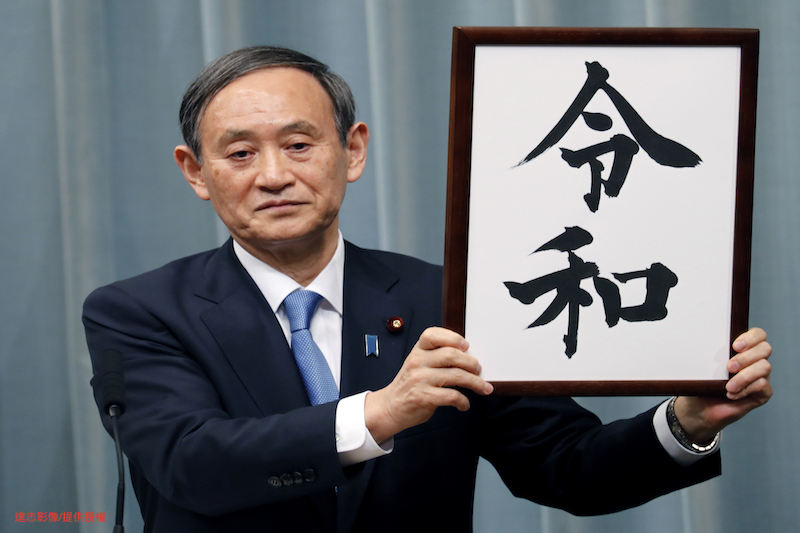
「令和」接替「平成」
The reign of Japan’s next emperor will be known as the Reiwa era, Cabinet chief secretary, Suga Yoshihide, announced at the prime minister’s official residence in Tokyo on April 1st, unveiling a framed calligraphy that presented the two Chinese characters chosen to write the name.
日本下一任天皇統治的時代將被稱為「令和」,內閣官房長官菅義偉於4月1日在東京首相官邸宣布這個消息,並展示上面寫著「令和」漢字的裱框書法。
reign(n.)(帝王)當政;統治(時期)emperor(n.)天皇;帝王Chinese characters漢字unveil(v.)(首次)介紹、展示、將公諸於眾=reveal=make public
The expectant nation was brought to a standstill as the new imperial era name, or gengo, was finally revealed after months of secret deliberations. Only a select group of scholars and senior politicians had known about the final choice.
經過數月的秘密審議,新天皇年號終於公開,日本全國上上下下都屏息期待著,先前只有一小部分學者和高階政治人物才知道最終的選擇。
expectant(adj.)(對愉快或令人激動的事情)期待的;渴望的;盼望的bring sth. to a standstill 讓某事情陷入停擺、停頓deliberation(n.)考慮;討論(=discussion)
The current era Heisei will give way to Reiwa on May 1 as Emperor Akihito abdicates and his eldest son, Crown Prince Naruhito, will formally accede to the throne.
五月一日明仁天皇將退位,由長子德仁將正式繼承王位,現在的平成時代將劃下句點,年號將改成令和。
give way to sth. 被取代=be replaced with~abdicate(v.)退位、讓位、(正式)放棄王位=resign from the throne=retire from the throne=step downaccede to the throne即位;登基
Akihito, 85, hinted at a desire to retire during a rare televised address in 2016, saying he feared his advanced years would inhibit his ability to perform official duties.
現年85歲的明仁天皇在2016年時罕見地發表電視演說暗示打算退休,表示擔心自己年邁無法善盡天皇職責,
advanced years 年邁;年老inhibit(v.)抑制;約束=slow down
He is the first emperor to abdicate since 1817.
明仁是日本自1817年以來第一位在世退位的天皇。
since(prep.)自從…之後
The new imperial era name Reiwa consists of two Chinese characters, derived from the eighth century Japanese poetry anthology, Manyoshu, which contains a series of 32 traditional Japanese poems relating to the plum blossom.
新天皇年號令和由兩個漢字組成,取自八世紀的日本詩集《萬葉集》,其中包括一系列三十二首以梅花為主題的日本傳統詩歌。
consist of~(恆主動)=be made up of~=be composed of~be derived from~來自於;源自於=come from=originate from…anthology(n.)(詩歌)選集=collection
“Rei” can be read as “fortunate” or “auspicious”, whereas “Wa” means “peace” or “harmony”.
「令」可以被詮釋為「幸運」或「吉祥」,而「和」則可以被理解為「和平」或「和諧」之意。
auspicious(adj.)吉利的、吉祥的whereas(conj.)而;然而=whileharmony(n.)和諧
Prime Minister Shinzo Abe pointed out that the name not only has connotations of spring and renewal, but also contains a wish for a Japan where everyone and their hopes for the future can blossom.
首相安倍晉三指出,這個名字不僅有春天和重生的涵義,而且包含了對日本的期許,願每個人與他們對未來的希望都可以綻放。
not only A but also B 不僅…而且…connotation(n.)內涵意義、隱含意義、聯想意義=hidden meaning
Abe said “Our nation is facing a big turning point, but there are many Japanese values that shouldn’t fade away. We are very proud of our history, culture and tradition, and this term expresses the Japan of tomorrow, the one we want to build for future generations.”
安倍說:「我們的國家正面臨一個重要的轉捩點,但有很多日本的價值觀不應該消失。我們以自己的歷史、文化和傳統自豪,這個詞表達了對未來日本的期許,一個我們希望為子孫後代打造的日本」。
turning point轉捩點fade away 漸漸消失future generations下一代